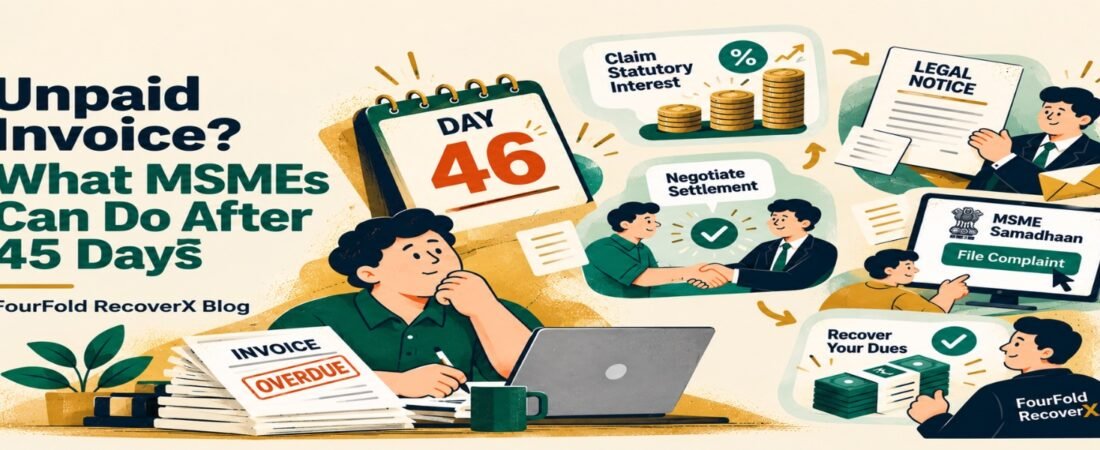
You delivered the goods or finished the service, and the invoice went out weeks ago. Now it’s day 46 and the buyer still hasn’t paid. Many small business owners wait and hope at this point, because they don’t want to damage the relationship.
The law is on your side, though, and waiting costs you money. Here’s what you can do once the 45-day mark passes.
The 45-day rule
Under the MSMED Act, 2006, a buyer must pay within the period agreed with the supplier, and that agreed period can never exceed 45 days from the day of acceptance or deemed acceptance of the goods or services. If nothing is agreed in writing, the limit is 15 days.
A purchase order that says “payment in 90 days” doesn’t change this. Such a clause does not extend the statutory limit beyond 45 days.
Who is protected? The delayed-payment provisions cover micro and small enterprises that are registered, which today means holding an Udyam registration. Sections 15 to 24 of the Act protect a “supplier” defined this way. If you aren’t registered yet, do it first.
Late payment means interest
Once the deadline passes, the buyer owes more than the invoice. The buyer must pay compound interest with monthly rests at three times the bank rate notified by the RBI, regardless of any contrary agreement. This is a heavy rate, and it exists to discourage late payment. (Check the current RBI bank rate when you calculate your claim.)
Your step-by-step options
Step 1: Gather your paperwork. Collect the invoice, purchase order, delivery challan or proof of service, any acceptance email or message, and your Udyam certificate. Without proof of delivery and acceptance, a claim becomes harder to prove.
Step 2: Send a polite written reminder. A short email or letter noting the invoice number, the due date and the amount often gets results. Keep a record of every follow-up.
Step 3: Send a formal legal notice. If reminders fail, a legal notice shows you are serious. It should list the invoices, the acceptance dates, the principal outstanding and the interest accrued, and cite the relevant sections of the MSMED Act. Finance teams often act quickly once a legal notice reaches them.
Step 4: Consider a settlement. Many disputes end with a negotiated settlement: the principal paid in full or in instalments, possibly with part of the interest waived to close the matter quickly. A settlement can be better than a long dispute, especially when the buyer is a long-term customer.
Step 5: File a complaint on MSME Samadhaan. If the buyer still doesn’t pay, you can approach the Micro and Small Enterprises Facilitation Council (MSEFC) of your state through the MSME Samadhaan portal. The MSEFC examines the case and can direct the buyer to pay the due amount along with interest under the Act. The Council is expected to decide a reference within 90 days.
A tax angle that helps you
Section 43B(h) of the Income Tax Act now encourages buyers to pay micro and small suppliers on time, since they can claim a deduction for such payments only if made within the permitted period. When you follow up, a polite note about this often gets attention from the buyer’s finance or accounts team.
Mistakes to avoid
- Assuming interest starts after your agreed credit period. Agreeing in writing to 60 or 90 days’ credit and then assuming interest runs from day 46 is a common error, so work out the correct start date for your claim.
- Delaying too long. Records get lost, contacts leave and the buyer’s situation can change. Act early.
- Skipping documentation. Keep written records of orders, delivery and communication.
- Missing details on the invoice. Mention your Udyam number and state that interest under the MSMED Act applies on late payment.
Prevent the problem next time
- Put clear payment terms (45 days or less) in every purchase order.
- Mention your Udyam registration and the interest clause on all invoices.
- Check a new buyer’s payment history before extending credit.
- Track receivables weekly and follow up before the due date, not after.
How FourFold RecoverX can help
Chasing payments takes time away from running your business. FourFold RecoverX helps MSMEs recover outstanding dues through legal notices, MSME Samadhaan complaints and structured settlement support, so you can focus on your work while we follow up on your invoices.
Is an invoice overdue? Contact FourFold RecoverX today for a free review of your case.