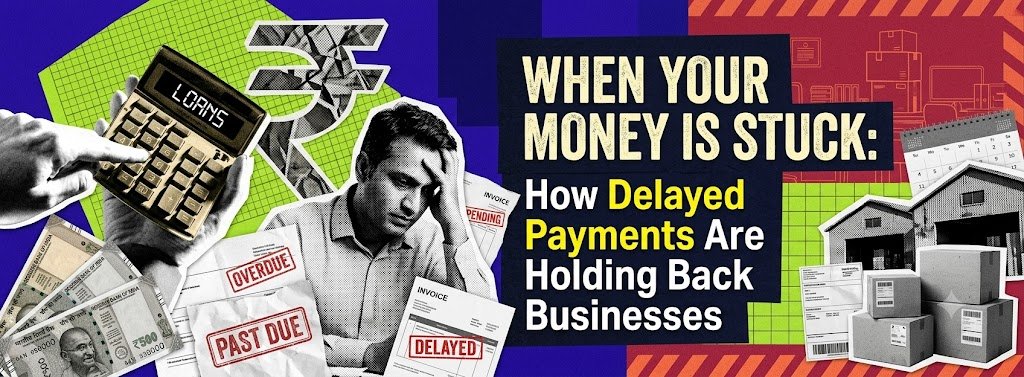
Business payments can get delayed for many reasons:
You delivered the order. You completed the work. You raised the invoice.
But the payment is still pending.
“Payment next week ho jayega.”
“Accounts team se approval pending hai.”
For many business owners, these lines are all too familiar.
A delayed payment may seem like a small issue at first, but when invoices remain unpaid for weeks or months, they can put real pressure on a business—especially for small and mid-sized businesses.
What Does “Stuck Money” Mean?
- Overdue invoices where the customer has missed the agreed payment date.
- Long payment cycles that stretch to 60, 90 or more days.
- Payment disputes related to quality, quantity, delivery or documentation.
- GST-related issues involving invoices, credits or refunds.
- Unresolved advance payments where goods or services have not been delivered as expected.
Whatever the reason, the result is the same: money that your business needs is not available when you need it.
How Delayed Payments Affect Your Business
Cash Flow Comes Under Pressure
A business can be profitable on paper and still struggle with cash flow. Salaries, rent, suppliers and daily expenses cannot wait for an overdue invoice.
Growth Gets Delayed
When your money is stuck with customers, you may not have enough working capital to purchase inventory, take new orders or invest in growth.
Supplier Relationships Can Suffer
If you cannot pay your suppliers on time because your own receivables are pending, the problem can quickly move through the entire payment chain.
Too Much Time Goes Into Follow-Ups
Repeated calls, emails and messages can take valuable time away from running your business.
What Can You Do About Pending Payments?
The first step is to stay organised.
Keep your invoices, purchase orders, delivery proofs, agreements and payment communications properly recorded.
Follow up regularly and keep a clear record of promised payment dates.
If repeated reminders are not working, don’t keep waiting indefinitely. Depending on the facts and eligibility of the matter, businesses may consider formal payment demands, legal notices, applicable MSME mechanisms, mediation, arbitration or other appropriate legal routes.
For eligible MSMEs, the MSME Samadhaan mechanism may also be relevant.
Don’t Let “Next Week” Become “Next Month”
A delayed payment doesn’t necessarily mean the money is lost. But the longer a legitimate payment remains unresolved, the more pressure it can put on your business.
The important thing is to understand:
How much is pending? Why is it pending? What documents support your claim? And what is the appropriate next step?
Need Help With a Pending B2B Payment?
FourFold RecoverX helps businesses and MSMEs understand and pursue structured payment settlement and legal routes for legitimate outstanding business payments.
Understand the dues. Assess the route. Take the next step.
[Get Started with FourFold RecoverX]